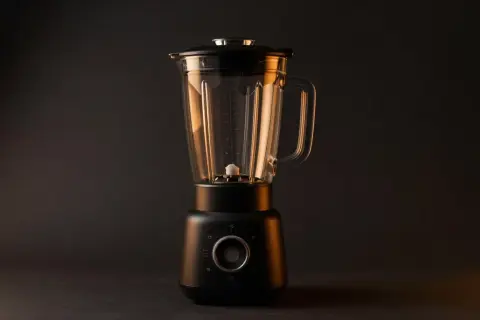
How much does it cost to run a blender?
At the EU average household price of 0.2832 EUR per kWh, a blender costs about 0.170 EUR per hour and 0.0057 EUR per use. Typical use adds up to 0.589 EUR a year, from 0.137 EUR in Turkey to 0.805 EUR in Ireland.
What the numbers assume
- Rated power
- 300 W to 1.5 kW, typical 600 W
- Average draw
- 600 W while in use
- One use
- 2 min, 0.01 to 0.05 kWh (typical 0.02 kWh)
- Typical use
- Two minutes of blending twice a week.
- Per year
- 104 × 0.02 kWh = 2.08 kWh
- Source
- Motor ratings from jug and high-speed blender specs (300 to 1500 W).
About blender running costs
The electricity use of a blender depends on its power rating and how long it runs. A typical blender uses about 600 watts, but models can range from 300 to 1500 watts. This means that a more powerful blender or longer blending sessions will use more energy.
Real use varies because different households blend for different lengths of time and at different frequencies. For example, one use lasting two minutes uses about 0.02 kWh, but this can range from 0.01 to 0.05 kWh depending on the blender's power and how it is used. Some people may blend more often or for longer periods, increasing their overall energy use.
Blender: yearly cost in every country
Typical use, all taxes included. Prices are in EUR so countries can be compared; the UK is converted from the Ofgem price cap at the ECB reference rate.
| Country | EUR/kWh | Per hour | Per use | Per year | Bar |
|---|---|---|---|---|---|
| Turkey | 0.0657 | 0.039 | 0.0013 | 0.137 | |
| Kosovo | 0.0869 | 0.052 | 0.0017 | 0.181 | |
| Bosnia and Herzegovina | 0.0995 | 0.060 | 0.0020 | 0.207 | |
| Montenegro | 0.1039 | 0.062 | 0.0021 | 0.216 | |
| Hungary | 0.1139 | 0.068 | 0.0023 | 0.237 | |
| North Macedonia | 0.1168 | 0.070 | 0.0023 | 0.243 | |
| Albania | 0.1190 | 0.071 | 0.0024 | 0.248 | |
| Serbia | 0.1197 | 0.072 | 0.0024 | 0.249 | |
| Malta | 0.1268 | 0.076 | 0.0025 | 0.264 | |
| Bulgaria | 0.1341 | 0.080 | 0.0027 | 0.279 | |
| Croatia | 0.1816 | 0.109 | 0.0036 | 0.378 | |
| Moldova | 0.1872 | 0.112 | 0.0037 | 0.389 | |
| Slovakia | 0.1985 | 0.119 | 0.0040 | 0.413 | |
| Norway | 0.1993 | 0.120 | 0.0040 | 0.415 | |
| Luxembourg | 0.2023 | 0.121 | 0.0040 | 0.421 | |
| Iceland | 0.2076 | 0.125 | 0.0042 | 0.432 | |
| Estonia | 0.2118 | 0.127 | 0.0042 | 0.441 | |
| Slovenia | 0.2118 | 0.127 | 0.0042 | 0.441 | |
| Lithuania | 0.2162 | 0.130 | 0.0043 | 0.450 | |
| Portugal | 0.2367 | 0.142 | 0.0047 | 0.492 | |
| Denmark | 0.2375 | 0.143 | 0.0048 | 0.494 | |
| Greece | 0.2401 | 0.144 | 0.0048 | 0.499 | |
| Latvia | 0.2415 | 0.145 | 0.0048 | 0.502 | |
| Netherlands | 0.2440 | 0.146 | 0.0049 | 0.508 | |
| France | 0.2485 | 0.149 | 0.0050 | 0.517 | |
| Spain | 0.2509 | 0.151 | 0.0050 | 0.522 | |
| Cyprus | 0.2688 | 0.161 | 0.0054 | 0.559 | |
| Finland | 0.2694 | 0.162 | 0.0054 | 0.560 | |
| Romania | 0.2836 | 0.170 | 0.0057 | 0.590 | |
| Czechia | 0.2884 | 0.173 | 0.0058 | 0.600 | |
| Liechtenstein | 0.2988 | 0.179 | 0.0060 | 0.622 | |
| Poland | 0.2999 | 0.180 | 0.0060 | 0.624 | |
| Sweden | 0.3062 | 0.184 | 0.0061 | 0.637 | |
| Italy | 0.3142 | 0.189 | 0.0063 | 0.654 | |
| United Kingdom | 0.3143 | 0.189 | 0.0063 | 0.654 | |
| Austria | 0.3260 | 0.196 | 0.0065 | 0.678 | |
| Belgium | 0.3575 | 0.215 | 0.0072 | 0.744 | |
| Germany | 0.3618 | 0.217 | 0.0072 | 0.753 | |
| Ireland | 0.3871 | 0.232 | 0.0077 | 0.805 | |
| EU-27 average | 0.2832 | 0.170 | 0.0057 | 0.589 |
the same blender costs 0.669 EUR more a year in the dearest country
Compared with alternatives
Yearly cost for each appliance's own typical use at the EU average price. Uses differ, so treat this as a rough guide; the comparison pages line them up on the same task.
How to cut the cost of running a blender
- Use the lowest power setting that still achieves your desired result to reduce energy use during each blending session.
- Clean the blender immediately after use to prevent food residue from building up and affecting its efficiency over time.
- Choose a blender with a motor rating around 600 W as it typically balances performance and energy use well for most tasks.
- Limit blending time to the minimum needed by ensuring ingredients are pre-cut and measured before starting.
Questions
- How much does it cost to run a blender for an hour?
- At the EU average household electricity price of 0.2832 EUR per kWh (Eurostat 2026-S1), a blender costs about 0.170 EUR per hour of use. That assumes an average draw of 600 W while it runs. At full rated power of 600 W it would be 0.170 EUR per hour.
- How much does a blender cost per use?
- One use (2 min) uses about 0.02 kWh, which costs 0.0057 EUR at the EU average price. Efficient or small models use around 0.01 kWh (0.0028 EUR), large or heavily used ones up to 0.05 kWh (0.014 EUR).
- How much does a blender cost to run per year?
- With typical use (two minutes of blending twice a week) it uses about 2.08 kWh a year. That is 0.589 EUR at the EU average price, from 0.137 EUR in Turkey to 0.805 EUR in Ireland.